
Barra Cadabra in Porto Alegre, Brazil
Written by Berliner Seilfabrik Team
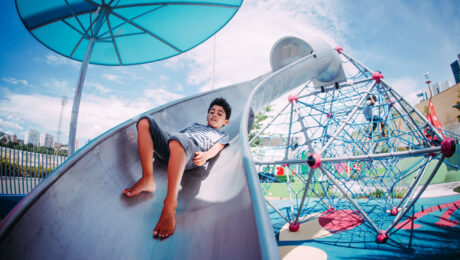
“A world of which we didn’t know if it really exists.” That was the title of the design concept for the new adventure playground of the BarraShopping Sul Mall in Porto Alegre in Brazil. Meanwhile, this world has become a reality. Since March of this year, visitors to the outdoor area of the shopping mall are attracted by a gigantic climbing, adventure, and play area which looks like a small leisure park. The park has an ambitious claim to fulfill the needs of children of all age groups and attract their parents, catering to the whole family.
“This space was created so we can stop in time and remember how we lost our ability to dream and imagine, and as we need that time to relive this fantastic world of children’s imagination”, says Susana Ventura, CEO and Creative Director of Oikotie, and mainly responsible for the planning and design of the new playground. “And children need it. Need to be children. So especially children in Brazil, where so many do not have the time to be children.”

The 2,500 sqm large area is subdivided into four different thematic areas which are equipped with a total of 39 different play devices, such as the “Sensorial Garden”, the “Magic Valley”, the “Event Area” and an adventure play area called “Bravaria”. In addition, the park offers an impressive infrastructure consisting of a family bathroom, a protected baby care center with all the practical amenities for infants, drinking water fountains, and different food stations.
While the children can experience all their senses in the “Sensorial Garden” with different musical instruments, water fountains and light effects, the “Magic Valley”, with its crooked little houses and fairy-tale creatures, offers spaces for imagination and relaxation. In addition, shows and meetings can take place on the stage of the “Event Area”.

“Bravaria – The land of the Bold and Daring”, offers a multifaceted athletic program of physical activities. Whoever dares can come here to enjoy climbing, sliding, spinning, swinging or jumping. A highlight of this area is the tree house settlement which was built by the company Berliner Seilfabrik. Climbing up the ladder, one reaches the first of a total of three little “Trii”-houses of the Berliner Greenville product range. Through a net tunnel the children can climb up to the next “Trii”-house. An access net allows direct entrance to the “Trii” in the middle and thus offers an exciting alternative to taking the ladder. Finally, another net tunnel leads to the third tree house, from where a tube slide offers courageous climbers a perfect descent from almost ten feet in height.

“This land was created for those who are brave enough to explore it. We created obstacles and high climbing areas, several difficulties, so that kids would have to overcome their fears and strength, when playing. Its also an area where moms and dads like to feel the thrill also, so it unites families in the adventure”, says Susana Ventura.

However, the challenges for the young adventurers do not only lie in climbing up to the tree houses or through the net tunnel, but also in the adjacent low-rope course which consists of four climbing elements, each of which provides different levels of difficulty. The so-called “Wasps’ Nest“, an open net ball made of ropes, which can be reached via a rope ladder or climbing ropes, offers an additional opportunity to have a rest and relax.

Another special climbing experience is provided by the three-dimensional net climber “Jupiter“. It is here where many children can play simultaneously in three-dimensional space and in up to sixteen feet in height. The extension elements, such as the slide, jungle bridge, access net, and rope ladder are additional attractions.

The same applies to the “Disk XL” which is also part of the Bravaria play area. With a diameter of over seven feet, this device, too, offers room enough for whole families without losing its elegance. The angled and concave disc form does not just provide fun but also helps to train one’s body control. It is here where one can experience G-forces in an impressive way.

The offers of this play area are rounded off by the new so-called “Side-by-Side-Swing” which consists of two separate swings as well as a net swing which is ideally suited for swinging together up to lofty heights.

All of the three, the “Jupiter”, the “Disk XL” and the “Side-by-Side-Swing”, provide inclusive value by allowing children with different abilities to play together. They provide numerous challenges for the different motor skills as well as varied sensory experiences. Children with hearing impairments, for instance, can climb inside the spatial net and simultaneously stay in visual contact with other children. ADHD patients benefit from having to concentrate when they are climbing, whereas children in wheelchairs can experience gravity and centrifugal forces together with others on the “Disk XL”. The safety surface chosen allows easy accessibility for all users and even children depending on wheelchairs will be motivated to leave their wheelchair and move on through the spatial net.

In addition to the wide range of movement and fitness offerings, it is an exciting color design and the varied modeling of the ground which are particularly eye-catching. An organic hilly landscape is created through elevations of different heights and the existing hills. Between the play structures, there are flower beds with palm trees, regional and exotic plants and herbs which offer a wide range of colors and scents. This external appearance is supported by the colorful EPDM surface which consists of round forms and paths of different colors which remind of a colorful meadow from a bird’s-eye view. Berliner Seilfabrik, in turn, has adjusted the color scheme of its play devices accordingly, most of which “are shining” in the colors blue, grey and pink and thus look particularly fanciful. “We are especially fond of all the color possibilities that Berliner gives us because color in our projects always has a high presence. Berliner also has very high quality material and high resistance, and this was an important issue when you think of a park which has more than 1.500 kids playing there every day”, Ventura says.

The contracting entity is very happy with the implementation: “By providing our customers with special experiences based on the demands of BarraShopping Sul, we have developed a unique concept consisting of innovative play devices for the whole family”, says Eduardo Vitagliano, Manager of the Shopping Mall, as quoted on the website of the Multiplan Group. The visitor numbers show that he has had his finger on the pulse of age: already in the first three weeks after the park was inaugurated, it has been visited by more than 52,000 people. That is a great success for both the operators of the Shopping Mall and particularly for the children and their families of Porto Alegre.
This is a project reference of Berliner Seilfabrik, in Brazil. If you would like to create a relevant custom-made solution in Greece or Cyprus, please do not hesitate to contact with us at info@eliteareas.gr
- Published in berliner
Playground for a Housing Association
Written by Berliner Seilfabrik Team
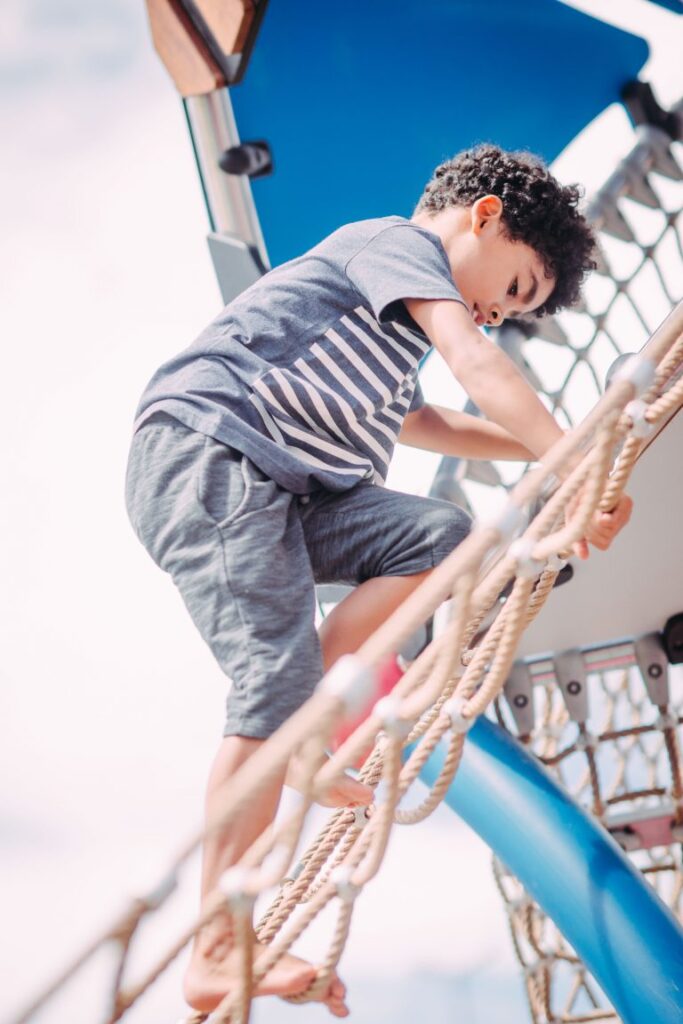
With its own housing stock of around 60,000 apartments, the Berlin-based housing association HOWOGE is one of the ten largest landlords in Germany. For more than 25 years, the company has stood for sustainable inventory development, innovative housing concepts, and social engagement at various locations in Berlin. In the course of the periodic repair of the façade of a block of flats with 422 apartments in Berlin’s Hohenschönhausen district, the outdoor area was also redesigned. A varied children’s playground was created in the courtyard of the building complex. Due to the public accessibility of the farm, the play area not only benefits the immediate residents but also offers the entire living environment – including adjoining daycare centers – an exciting destination for play and movement.

“It was important to me to have a playground that caters to the needs of all ages,” said Oliver Pohlann, Landscape Architect in charge and Project Manager of Landscaping at HOWOGE. “Both the very young children and the older ones in adolescence should get their money’s worth.”

Consequently, the playground consists of play equipment with different requirements. At the heart of the toddler area is the Roo M.03 playhouse of the Spooky Rookies series, which is specifically geared to the needs of toddlers under the age of 3 for early psychomotor and social development. For example, the mud tables in the lower part of the playhouse invite you to role-play, which promotes language and social skills in a playful way. An ascent ramp makes it possible to reach the upper area of the house before descending the child-friendly slide – a form of exercise that has a positive effect on spatial perception and improved balance and coordination skills of small children.

The highlight of the play area for the “big ones” is a combination of the wooden playhouses Woodville, in which two different “shacks” share a common post. The larger of the two shacks is equipped with a transitional network, which is combined with an access net. The two shacks are connected through a balcony that can be climbed via a rope ladder or using the rocking-plate ascent. “The promotion possibilities are deliberately chosen so that they offer different levels of difficulty and also offer an exciting challenge for older children,” says Pohlann. “Even when choosing colors, it was important to me that the ropes, balls, clamps and roofs look as interesting and appealing as possible. At the same time, of course, the play equipment should fit in color with the new façade design of the adjoining apartment blocks.”

Responsible for the development of Woodville at the Berliner Seilfabrik is Katharina Hilger, engineer of the Berlin Creative Center: “My personal highlight of the Woodville playground equipment is the constructive and elegant wood protection. Both from above and from below, the wood is protected by other materials. The elevation is part of the design and the round logs do not end in the usual metal post shoes.

In addition, I am pleased about the hybrid character of individual components. This means that the parts that are subject to heavy loads when playing do not connect directly to the wood, but to stainless steel pipes, which are much more stable and resistant – and thus contribute to the longevity of playground equipment.

Rounding out the playground are two play points of the Berlin product group URBAN DESIGN. The double swing Swingo.2.4 allows two children to swing at the same time and was set for Pohlann from the beginning: “Rocking is important for a playground, it always works!”

In addition to its stylish organic design, the rocker abacus impresses with three sliding weight balls. Depending on the weight ratio of the users, these can be shifted so that people of different weights can be balanced and swung together. At the same time, the play point illustrates essential physical relationships in terms of gravity and balance. Here the children have the opportunity to get in contact with the scientific laws in a playful way.

“Not only the tenants of the adjoining apartments and the surrounding kindergartens are more than satisfied with the redesign of the playground, but also incidentally passing bypassers are now more often in the courtyard on the Dierhagener road,” says Oliver Pohlann. HOWOGE has thus lived up to its motto “more than usual”.
This is a project reference of Berliner Seilfabrik, in Germany. If you would like to create a relevant custom-made solution in Greece or Cyprus, please do not hesitate to contact with us at info@eliteareas.gr
- Published in berliner
New School Playgrounds in Singapore
Written by Berliner Seilfabrik Team
“Celebrate your Roots – discover your Wings” is the guiding principle of the German European School in Singapore (GESS). Thus the school profile focuses on conveying the European values of respect, openness and a sense of community. The private school in the Asian metropolis is aimed at students and preschoolers of all ages between 18 months and 18 years old. The school aspires to get to know every student in the school community, to discover his personal strengths and interests and, through a holistic approach, to both encourage and challenge students. The school focuses on quality not only during lessons, but also beyond them. Thus the school concept sees recess as an opportunity to supplement and support cognitive learning in class through physical exercise. Social interaction is also encouraged during recess.

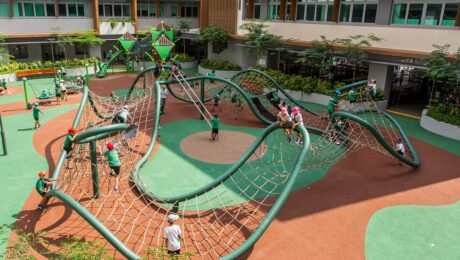
Consequently, the redesign of the school campus in Singapore has resulted in a wide range of activities and opportunities for relaxation and play. In addition to various sports areas, including a football field and an Olympic swimming pool, the newly designed play areas in the inner courtyards of the school complex are also particularly striking. The school playground is divided into a total of four areas aimed at engaging all age groups.
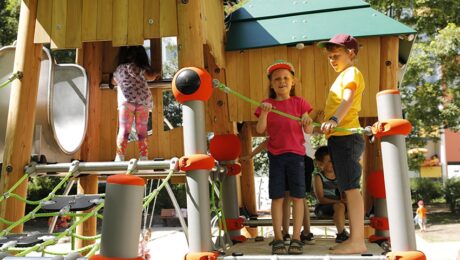
In the first courtyard there are two different combinations of playhouses and rope playhouses from the Berliner Greenville series, each connected by different bridge elements. The bases of the rope playhouses are three-dimensional nets made of ropes inside the “DoubleBoos”. Since spatial nets offer enough space for a lot of children at the same time, they are perfect for school playgrounds. In addition, playing together in the climbing net promotes the social behavior of the students, since interactions inevitably arise. Climbing in three-dimensional space also trains the students’ psychomotor skills and 3D-imagination. This has a positive effect on mathematics classes, among other things. Thus at the neuronal level, the interconnection patterns in the brain that are also required for three-dimensional computing are stimulated.

The playground in the first courtyard merges seamlessly into a second, covered play area. Here students can climb on a low rope course consisting of five different climbing elements. “As the individual elements of a low rope course have different levels of difficulty, they are attractive for children of differing ages”, says Patrick Lee, expert in designing playgrounds and schoolyards and managing director of CT-Art.

The completely open design of the rope play equipment ensures maximum transparency. This means teachers can observe their students from every perspective, even when there are a lot of children on the climbing equipment at the same time.

This design feature is particularly beneficial for school playgrounds and is also present in the wave-shaped play sculpture “Shout”, located in the third play area of the school. A planar net with different mesh widths spans a frame made of bent steel tubes. In addition to a net tunnel, which makes the climbing ring climbable all the way around, the play sculpture has numerous add-on elements such as climbing plates, a banister and rubber mats.

All in all, more than 200 children have room on “Shout” simultaneously and can thus get plenty of exercise during recess. The various add-on elements and the differences in height within the structure also make “Shout” attractive for all age groups. In addition, the abstract structure offers plenty of room for the imagination. “The pupils can always discover new entrances to climb into, play on and experience the play equipment”, says Patrick Lee. “This offers many opportunities for pupils to act out their own play ideas and thus supports the vision of the school to promote the personal interests of each individual.”


The second large play structure in this area is a combination of three “Greenville” Trii houses of differing heights, connected by net tunnels. Students can find space up there for privacy, or rest and relax after a challenging climbing tour in order to recover before classes resume.

This play area is rounded off by two nest swings and a rotating play point. Both devices offer play functions that have a positive effect on children’s development. While swinging particularly promotes the vestibular system, i.e. the ability to coordinate body movements, eye movements and balance, turning strengthens kinaesthetic awareness in that the child learns to avoid falling down or colliding with other playmates.

In the fourth play area of GESS, a combination of two playhouses from the “Spooky Rookies” product line has been installed. This is specially tailored to the needs of small children. The two different access points, a flat ramp and a small staircase, allow age-appropriate access and at the same time offer an exciting challenge for the little ones. In addition, the passage over the close-meshed net bridge or a sliding section in the toddler slide trains the sense of balance and thus fosters the next developmental stage. Patrick Lee is satisfied: “With the counter in the lower part of the larger house, the playhouses offer the ideal space for role-playing games. Language and social skills such as empathy are developed in a ludic way.”


In addition to the high play and exercise value, the clear, organic and natural design language running through all the play areas is particularly striking. The natural color choice and the use of bamboo panels in the area of the facade elements reference the green surroundings of the “Bukit Timah Nature Reserve”, located directly in front of the GESS school gates. “The intention was to transfer this stimulating environment into the school playground through natural design”, says Marius Kotte from the Berliner Creative Centre.

With the redesign of the outdoor area of the GESS, an impressive play and exercise area has been created that not only appeals to all age groups, but at the same time fosters the students’ neuronal, social and psychomotor development.
This is a project reference of Berliner Seilfabrik, in Singapore. If you would like to create a relevant custom-made solution in Greece or Cyprus, please do not hesitate to contact with us at info@eliteareas.gr
- Published in berliner
Sonoma Country Day School, California
Written by Berliner Seilfabrik Team
Located in northern Santa Rosa, California, the Sonoma Country Day School, an independent TK-8 college preparatory school, provides students with state-of-the-art facilities, challenging core academics and a focus on the creative and performing arts. For more than thirty years, it has been the school that “brings learning to life.”

When it came time to design the playground, the school wanted one that reflected its mission. They did not want a traditional-looking playground with traditional playground equipment. They wanted something different, something that was more challenging for the children, something that truly reflected the school.

Important elements for the design included: incorporating an existing hill and elevation into the plan, using natural materials, choosing the right colors and being cognizant of the environment. Berliner’s bamboo-paneled play equipment, which look like wood, offer greater durability and are more ecologically friendly, fit their vision.
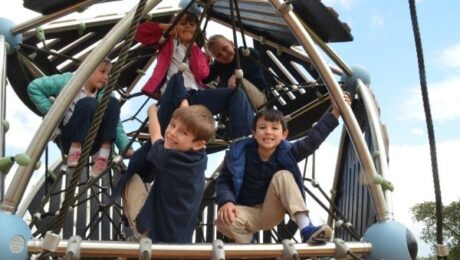
While incorporating the hill had its challenges, such as access, the Berliner Triple Boo offered the perfect solution. The Triple Boo gives the look of a classic play house with its bamboo panels. Standing 13 feet tall, it utilizes the space well by providing play space upward, maximizing play space on a minimal ground area. It also contains a 3-dimensional rope climbing web beneath it for kids to climb in and up to the tree house. The open tube provides ADA access to the structure, enabling play for all.

The 3-story Triple Boo sits atop the hill, creating a focal point for the playground and a destination for the children.

The Joe Brown Globe, a spatial net climber with a wooden frame and natural colors, is a unique wood play piece that complements the natural playground setting. Made of glued timber, the multiple layers of dried wood make it the premier choice for a natural material while offering maximum load capacity and minimal cracking or splintering. The foundation, made of powder-coated steel fitted into the wood elements, means there is no direct connection between the bottom of the wood structure and the soil, eliminating the possibility of moisture or water damage to the equipment.

At the bottom of the hill, you’ll find more bamboo-paneled play equipment, the 2-story Double Boo with spatial net connected to a Trii with a banister and ladder.
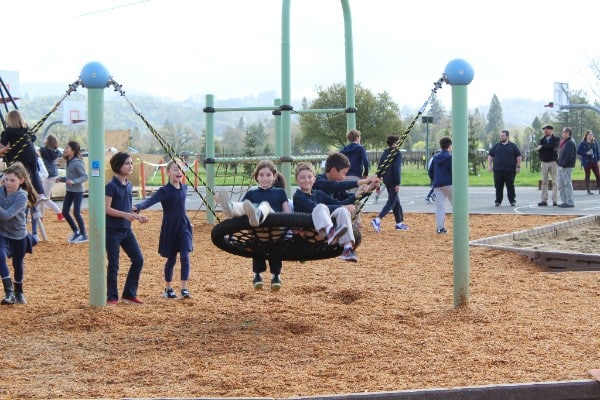
The O’Tannenbaum spinning tree enables kids to climb and spin at the same time. Except for its trunk, the entire tree rotates. The big rubber membrane surface with its low access height enables children with special needs to join the fun, providing a place where kids can sit while spinning.
The Double Cloud 9, an accessible swing, allows several children at one time to fly on the cloud and children with special needs can enjoy the swinging movement, too.
Other Berliner play structures that complement the natural playground setting:
Swinging to and fro all the time, the Cat Tail gives children a rocking play experience. The body and stem are made of stainless steel and have a bi-colored HDPE platform to make it more aesthetically pleasing, blending with the playground’s surroundings.
Children zoom from one side to the other using the 100-foot Speedway zip line. The Speedway is a fun cable ride without bulky supports. The two big steel arches allow for a more open design and can be equipped with a launch platform.
All in all, the Berliner design team successfully met the expectations of the school.
This is a project reference of Berliner Seilfabrik, in California. If you would like to create a relevant custom-made solution in Greece or Cyprus, please do not hesitate to contact with us at info@eliteareas.gr
- Published in berliner
Be’er Sheva River Park, Israel
Written by Berliner Seilfabrik Team
Be’er-Sheva in southern Israel is one of the country’s largest cities. It is considered by many to be the “Capital of the Negev,” which it borders on. As a so-called “developing city,” Be’er-Sheva has been turning into a religious center and has also become an important Israeli metropolis over recent decades.
In order to maintain the city’s attractiveness for its 200,000 inhabitants, it is crucial to create attractive facilities for young families. In addition to emerging residential neighborhoods, the growing industrial sector and increasing tourism, new local parks have been established in the last few years. One of these is Be’er-Sheva River Park. Covering an expanse of several square miles, the large River Park follows the course of Nahal Be’er-Sheva, a large riverbed that does not carry any water during the dry season.

As of June 2017, the park boasts a new centerpiece: a massive playground consisting of a vast climbing landscape made up of equipment provided by Berliner Seilfabrik.
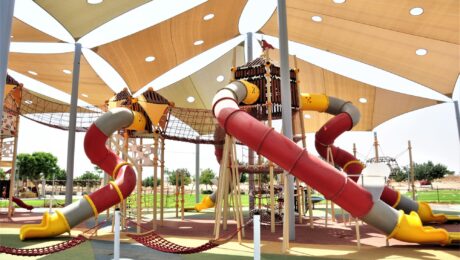
Seven differently equipped climbing towers are evenly distributed over an area of approx. 10,765-ft.² They serve as the foundation pillars of this climbing paradise. The towers are connected with net bridges that are up to 20 feet in length. Some of the bamboo-clad towers are more than 26 feet high, giving them the appearance of a tree house village thanks to their natural design.
Besides its remarkable size and complexity, another special feature of the playground is its density of climbing structures and the way these are connected. Any “gaps” have been filled using additional exciting equipment. Climbing mats, ladders, nets and climbing ropes add many more options for climbing and playing, making the playground even more versatile. A neighboring lower rope course for children who are not quite ready to make their way up to the “treetops” offers additional variety and an exciting challenge for smaller children.
In addition, six long, slightly twisted or even spiralling slides have been attached to the climbing towers. Whizzing down one of these slides is the perfect reward to every bold climber! The slides for this project were supplied by Israeli partner Games & Sports and could be easily attached to the towers thanks to Berliner Seilfabrik’s modular system.
Around the climbing structures, numerous additional attractions such as seesaws and carousels complete the playground’s range of activities in an impressive fashion.

The new climbing landscape has been designed in cooperation with Games & Sports Head of Design, Galina Man, and the company’s Vice President of Marketing, Meirav Moshka, with the planners at Berlin’s Creative Centers. Roei Shabtay, Executive Assistant to the CEO at Games & Sports, is more than happy with the result. In particular, he loves how “every area offers a different activity”.

Another specialty of the playground is its distinctive canopy. The entire climbing structure is protected by multiple shade sails arranged in a star-shaped pattern. As severe dust storms can be quite a frequent occurrence in the Be’er-Sheva region, these sails give not only shade, but also protect the playground structures and their users from the bothersome fine grains of sand. Several poles were installed to attach the canopy.
Roei Shabtay explains, “We had to pour a joint foundation to be able to anchor this great number of poles in the ground. The poles for the playground equipment and the poles for the shade sails share one foundation.” Despite the large amount of poles in one place, the designers managed to observe the necessary clearance distance, thus ensuring maximum safety for the children.
This is a project reference of Berliner Seilfabrik, in southern Israel. If you would like to create a relevant custom-made solution in Greece or Cyprus, please do not hesitate to contact with us at info@eliteareas.gr
- Published in berliner
South Park, San Francisco
Written by Berliner Seilfabrik Team
South Park, San Francisco’s oldest public park, is a unique and historical area. The park, modeled after an English strolling park, was originally built as the centerpiece of this exclusive neighborhood. Years of activity, however, took their toll and the park fell into disrepair.

The Recreation Park Department, South Park Improvement Association, park neighbors and community leaders wanted to restore it to its original glory. Fletcher Studio Landscape Architecture, an award-winning landscape architecture firm, was commissioned to develop a master plan for the park, bringing the revitalized vision to reality. The new design can be described as a contemporary interpretation of the English strolling garden.

The project entailed upgrading the park’s infrastructure, including new paths, irrigation, drainage, site lighting, landscaping, swooping meadows and a new stage area for performances.

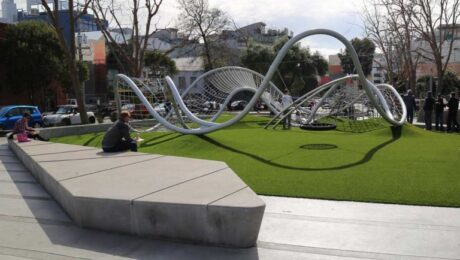
One striking addition: a custom universal play area with undulating forms both in structure and in the mounded surface. This flowing contemporary design by Fletcher and the 100% custom designed structure by Berliner makes it a truly one-of-a-kind design, one that has never been done before!

David Yosso, President of Specified Play Equipment Company and Berliner’s exclusive representative for Northern California, calls the South Park design a “sculptural, playful art piece designed for all ages and imaginations.”

From a bird’s eye view, the play structure appears to be a perfect circle. From an elevation view, you see the undulations and curvatures.
The undulating curvatures rise from two feet to 10 feet with no visible upright posts. All posts, six of them, are below grade. The mounding underneath the playground follows the curvature of the equipment, effectively hiding the upright posts and making the structure appear to float.

The different types of nets offer various degrees of challenge with plenty of footing and handholds for children to safely climb up and down, horizontally and vertically. Net climbers offer visual transparency, keeping sight lines open.
Berliner’s proprietary Charlotte Connectors, which make the rope ends disappear inside the steel tubes, allow for tension adjustments to be made on site, resulting in a more harmonic net geometry as well as improved longevity.

This structure offers a perfect example of the optimum amount of risk with no single route and no known conclusion!
The modern, almost industrial color choice reinforces the concept that this is more than a playground; it is almost like public art, complementing the many tech-related and design companies that call South Park home.
Play elements integrated into the flowing design include a banister, which provides an elegant alternative to a slide, and a multi-user, accessible saucer swing.

The playground in any community provides a distinctive landmark; however, South Park is more than a playground. It provides a lesson in redesigning a public space; combining the play value needed by children with the aesthetic appeal and style desired by adults – making it the perfect place for the whole family.
This is a project reference of Berliner Seilfabrik, in San Francisco. All photos courtesy of Fangzhour Miao and Chris Watkins. If you would like to create a relevant custom-made solution in Greece or Cyprus, please do not hesitate to contact with us at info@eliteareas.gr
- Published in berliner
Rope Play Takes Inclusive Play to a New Level
Written by Berliner Seilfabrik Team
Goggle “INCLUSIVE PLAY” or “inclusive playgrounds” and you will find pages of entries – what it is, where you can find such playgrounds, who offers “inclusive playground equipment” and more.
Delve into this more and you will also find that many traditional inclusive playgrounds primarily focus on children with physical disabilities, failing to include those without physical disabilities or those without disabilities at all.
This raises the question: what kind of inclusion experience is it if it is neglecting over 90% of children who don’t have any disabilities at all to play?
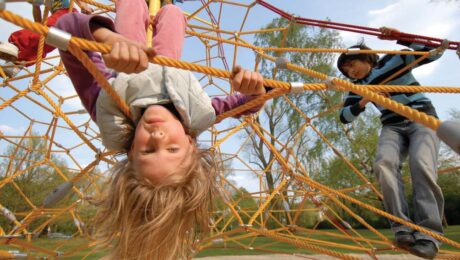
There are many kinds of playground equipment that provide an “inclusive” experience; however, rope play equipment, net climbers, offer something for everyone, providing a more unique and ever-challenging experience for all abilities.

So, What is Inclusive Play?
In general, inclusive play bridges the gap between mainstream and children with special needs. Inclusive play enables children to better relate to one another, whether they have a special need or not, opening their eyes to the world around them.
Inclusive play enables better social integration. Learning about each other’s differences at a younger age can help children feel comfortable around those who are different.
Many children happily play together without noticing any differences. Encouraging children of all abilities to play together teaches them to treat each other the same.
Accessible or Inclusive Playground – What’s the Difference?
A 100% accessible playground goes beyond ADA Compliance, enabling
everyone to get to and move all around the playground. Children in wheelchairs could, for instance, reach the highest point of a structure through ramps. Being ADA Compliant Means…
All new and renovated parks must have an accessible path leading to the playground with nothing blocking it. A paved path and railing facilitates access for children with disabilities and helps meet ADA regulations. Integrating a very tightly stretched rope, for example, into the playground may make the use of a cane for a visually impaired child unnecessary, freeing the child’s hands for climbing. On the other hand, an inclusive playground accounts for human diversity in the community. That means, it offers barrier-free attractions while at the same time providing challenging and fun experiences for a wide variety of children – those without any disabilities along with those with ADHD, Down’s syndrome, sensory processing, visual or hearing impairments and other physical and developmental issues.

An inclusive playground offers a balance of play experiences for all abilities, achieving parallel play as much as possible. It enables children to embrace and experience their commonalities and differences as autonomously as possible and in close proximity to one another.
It is not about “leveling down” the experience nor is it necessary to remove every sandbox so that a child with little mobility does not notice that he or she cannot run.
Inclusive play and accessible play are often lumped together when accessibility is only a small part of what makes a playground inclusive. The ramps alone are merely an accessibility device and do not by themselves lead to engagement with other children. On the other hand, rope play equipment does.
How Rope Play Adds to the Inclusive Experience
Net structures, or rope play equipment, only serve to enhance the play experience for children, whether at an accessible or inclusive playground. The unique free play and net climbing configurations challenge a child’s motor skills, increase their self-confidence, stimulate imaginative play and improve muscle development and balancing skills.
One strength of rope play equipment lies in the motor challenge that they pose to children along with the endless play options. When climbing, a child’s progress requires control and focus, each step and each grip is a new decision, keeping it challenging and fun every time.

3-Dimensional vs. 2-Dimensional Rope Equipment
Two-dimensional rope structures offer paths for a child to climb vertically, horizontally or possibly across on a bridge or link.
Three-dimensional rope structures come in all shapes and sizes and are commonly referred to as space nets and net climbers. Structures can be quite tall or closer to the ground and full of low course challeng- es or a mix of both, enhancing the play experience with:
- No prescribed entry points
- No specific paths to be followed
- Open environment encourag- ing social interaction
One strength of rope play equipment lies in the motor challenge that they pose to children along with the endless play options. When climbing, a child’s progress requires control and focus, each step and each grip is a new decision, keeping it challenging and fun every time.

For every action, there is a reaction. As one child is climbing the rope structure, it causes a reaction to the other side of the structure. For children who have limited mobility or do not have the strength or desire to climb the structure, he or she can hold the rope and feel its movement, swaying back and forth, and be included in the play with others. Rope play equipment combines different difficulty levels in a single play element. For instance, older children or young adults who like to climb can romp in sections with larger distances between the ropes while younger children can test their motor skills in sections with narrower distances between the ropes. Children of all ages (and sizes) are part of the play experience.
A 3-dimensional net structure has no prescribed entry or exit point; it is up to the child to decide where to go in or come out. is, too, leads to endless play options.
It is important to note that play- grounds must meet all standards and rules of the ADA. That means that all play equipment of a certain size must have some type of transfer module, such as a transfer station or ramp, installed enabling a child to move (or transfer) from his or her wheelchair on to the play structure. The use of transfer modules enables a child in a wheelchair to reach play equipment such as a slide, providing him or her with an easy climbing challenge.

Transfer stations and ramps are not the only viable tools to ensure accessibility. The standard leaves room for alternate solutions if they result in equivalent or better usage. Access nets or other close to the ground nets meet that criteria.
On most rope structures the entire base perimeter serves as a transfer point to the climber. There is no need for an additional transfer module/deck. Rope play equipment encourages children to leave the wheelchair whenever possible.
Rope playground equipment with built-in seats, such as nest swings, are very accessible to children in wheelchairs. The spacious lying area often enables children with or without disabilities to swing together, encouraging social interaction.
The challenging nature of a low-level rope course offers visually impaired children the opportunity to climb safely as well as allowing children with hearing impairments to use sign language without hindrance.
The ropes make communicating among the children and their caregivers much easier. Some children may not speak or hear well. Play can be a wonderful tool for them to use to communicate. The transparency of the net structure enables children to use sign language when playing and eliminates barriers to visual supervision even on very busy playgrounds.
Rope equipment can incorporate elements that allow auditory, visual and tactile sensory experiences, which can capture a child’s interest, especially in children with a form of autism spectrum disorder or sensory processing disorder.
Net climbers provide a play space that brings together children with different abilities – those that may have a visual or hearing impairment, physical or mental disability or other developmental challenge – enabling them to experience their possibilities and their limits in common play, encouraging understanding and acceptance of one another.
If you would like to create a custom-made solution in Greece or Cyprus, please do not hesitate to contact with us at info@eliteareas.gr
- Published in berliner
Margaret Mahy Family Playground in Christchurch, New Zealand
Written by Berliner Seilfabrik Team
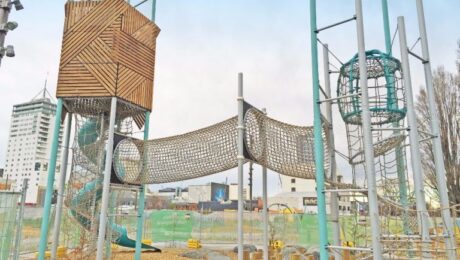
With the opening of Margaret Mahy Playground in Christchurch, New Zealand, June 25th 2016, one of the largest and most modern playgrounds in the southern hemisphere has arisen. It was built after the major earthquake that struck New Zealand in February 2011, which affected Christchurch in particular. The project was meaningful for all those involved, but in particular for the area’s inhabitants and visitors to the playground.

The detailed planning phase from early 2013 to mid-2015 included a playground design competition held among schools in the Canterbury region. Entries to this competition helped inspire the final design as drawn up by Berliner Seilfabrik.

The playground’s layout is based on Canterbury’s four main natural habitats: “The Forest”, “The Wetlands”, “The Plains” and “Coastal”. It consists of two different parts. The first section of the playground includes a large custom-made net of 22,5 m x 15 m, stretched across two enormous masts. The net is fixed through a total of 15 anchor points whose foundations are at different heights.

One of the greatest challenges facing the team at Berliner’s Creative Centre was to procure reliable topographical data from the park designers on the ground, since the creation of artificial hills was envisaged as part of the park’s landscape. “An inaccurate calculation of a few centimetres in height difference can lead to a misfit of the whole net. This results either in a sag or a net being too short.”, Marius Kotte, Architect and Head of Construction and Development said.

To prevent this, playground concepts were created, based on which preliminary drafts were then drawn up and offered. With the completion of landscape modelling, the entire site was surveyed. The resulting three-dimensional data set was used by Berliner Seilfabrik to create a virtual site. Based on this, the play structure was conceived, manufactured and installed on site with the utmost precision.
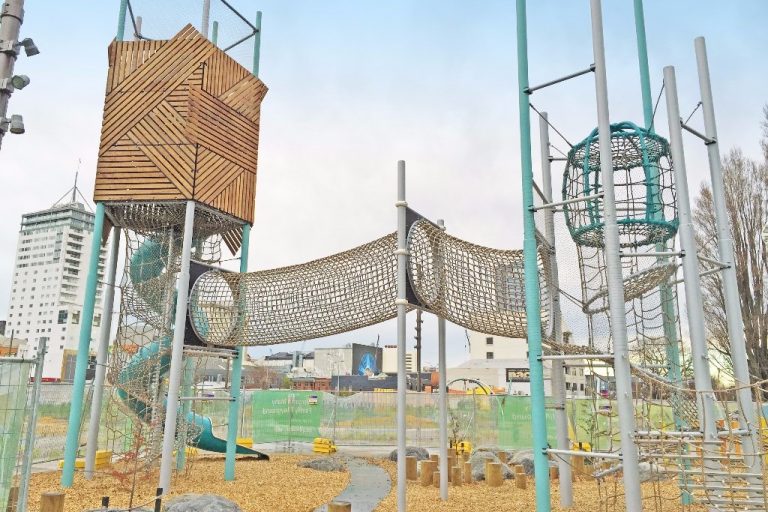
The playground’s second section is characterised by a gigantic tower combination designed and built by Berliner Seilfabrik. The structure consists of three large towers enabling children to climb up to eight meters above ground level. A spectacular spiral slide transports children from the top back down to ground level. Each tower is enhanced by bamboo panels, which has led to their being included in Berliner’s Greenville Towers & Triis product range. “The architect requested special posts and therefore we could not use our standard connector tube.

That’s why we invented a new fastening system which bears high design requirements and the long transportation route to New Zealand. The fact that welding on site was impossible was considered, too.”, Marius Kotte says. To ensure the identification of the individual posts in New Zealand, they have been marked by laser engraving.

As a result, a new and wonderful playground is now located in the Heart of Christchurch. Not only kids are excited, but also their parents and even their grandparents. Leez O’Connell took her granddaughter to enjoy the slide despite the rain. “I think it’s fantastic. Kids aren’t allowed to climb trees or anything anymore. So I really like seeing them all climbing up there and getting a bit scared. It’s so good for them,” she said in New Zealand´s Newspaper THE PRESS.
This is a project reference of Berliner Seilfabrik, in New Zealand. If you would like to create a relevant custom-made solution in Greece or Cyprus, please do not hesitate to contact with us at info@eliteareas.gr
- Published in berliner
Aventura-Europe’s longest playground structure

Written by Berliner Seilfabrik Team
It begins in a shaky fashion at the foot of Bromberg Hill. A large access net leads up to a treehouse-like tower. And this is just the beginning – the beginning of Europe’s longest climbing structure. Meandering 168 meters up the hill are a great variety of tunnels and bridges, balancing elements and rubber mats, which pass through multiple towers along the way.

Planning
“Aventura – Play Mountain” is located in Medebach, a small town and holiday resort in Hochsauerland, which attracts hikers in summer and skiers in winter. After a building phase that was completed in record time, the facility was officially opened at the end of September 2015, having already been given TÜV certification the previous month. The new “playground” is located on land provided by the town of Medebach and forms part of Center Parc, a family resort surrounded by nature. The facility can be used for free by resort guests, visitors to the region and local inhabitants alike. The idea for the construction of a large, recreational facility that was also required in some way to be the only one of its kind in Germany goes back a few years. In 2007, winter storm Kyrill left severe damage in its wake. It was Center Parc’s landscape architect and biologist, Jean Henkens who originally came up with the idea, drawing inspiration from Bromberg being known in history as “where the wind lives”. This led to the choice of air, one of the four elements, to be the underlying theme for the giant climbing structure.
The project was then further developed and implemented by the Paderborn based landscape architectural practice Gasse|Schumacher|Schramm in cooperation with Berliner Seilfabrik.
Implementation
“What makes the project unusual is its scale,” explains Marius Kotte, architect and head of the construction and development department at Berliner Seilfabrik. “Above all, we needed to pay the utmost attention to project management, since the project involved a great degree of planning and development as well as the preparation and implementation of various production processes. The challenge lay in our delivering this major order whilst not neglecting our other clients and their orders.” The project was sub-divided into nine segments, the manufacture of each segment being treated as an individual contract. Structuring the project in this way ensured its completion on schedule. Rising to the challenge of new product development during the construction process proved particularly successful. A number of innovations have been incorporated into Play Mountain: several towers are being seen for the first time, as are the connections between the segments and their connective elements, e.g. between tubes and joints. Although the tallest tower is 7.8 meters high, at no point is it possible to fall any further than the legally-permitted distance of three meters.

Nets inside lead the visitor to a long, spiralling tunnel slide. Another tower is distinguished by a special feature: by lying on a viewing net, visitors can marvel at the wonderful surrounding landscape. These towers are clad in bamboo panels. Berliner Seilfabrik selected bamboo not only because it is more durable than wood, but because it makes a smaller environmental footprint. Being a grass species, after harvesting bamboo can grow again, unlike wood.Suspended between the posts inside two towers are large cocoon-like spheres, access to these being via plate-shaped nets. It was important for these elements to be as transparent as possible while still remaining safe. With this in mind, they were enclosed in a safety net of fine mesh. Such netting was also employed where a small gully is traversed by the climbing structure, at which point a classic suspension bridge is used to cross above a cliff face. Approximately 2000 metres of bright red rope has been used for the 22 connecting elements of the structure. As well as the ever-popular net tunnels and classic suspension bridges, new transitional elements can also be seen, such as the liana bridge, a narrow net walkway suspended from long ropes, not to mention a tunnel enclosed in a rubber membrane. One segment—involving a combination of sloping and balancing—is particularly challenging. It is here that the far from fully grown visitors prove to have a distinct advantage. Also popular is the so-called chessboard bridge, comprising squares of rubber stretched between holding ropes. Here, the children can hop, sway and relax.

Foundations and Impact Protection
Close to thirty six tons of steel was delivered to the building site. Almost one hundred posts were used, the heaviest of which, at 10.4 metres long, weighed 450kg. Test drilling prior to the building phase on the upper reaches of the hill in November 2014 encountered solid rock near the surface. However, while excavating the foundations in June 2015, this rock turned out to be soft shale. The foundations for the posts had to be adjusted accordingly.
On the ground beneath the towers and platforms, the steep gradients were levelled off so as to prevent the impact protection material from being washed away by rain. In some areas wood chips were chosen for impact protection, while in others, turf was selected. The colours of both these blend in with nature while also ensuring the highest safety standards. Over time the lawn areas will change into flower meadows without compromising their impact protection properties.
The gradient of the slope is approximately 21 per cent, but can vary dramatically, at some places reaching as much as 46 per cent. The technical solutions devised by Berliner Seilfabrik allow for small modifications to be carried out to the structure on site. For example, the height of the so-called T joints, which fix rope, chains and tubing to the posts, are adjustable. This allows for any minor revisions to the plan deemed necessary in situ due to vagaries of the terrain.

For Small and Not-so-small Users Alike
Climbing to the top of the structure is not easy. But those who perhaps don’t as yet dare to go through the towers or cross the bridges can play to their heart’s content at the lower end of the facility in an area specially designed for small children. Here they are welcomed by two large nest-swings and “Trii”, a small tree house with a slide. For accompanying adults, a paved path runs parallel to the entire climbing structure.
This is a project reference of Berliner Seilfabrik, in Medebach. If you would like to create a relevant custom-made solution in Greece or Cyprus, please do not hesitate to contact with us at info@eliteareas.gr
- Published in berliner
MAGICAL, TWISTED, CRAZY
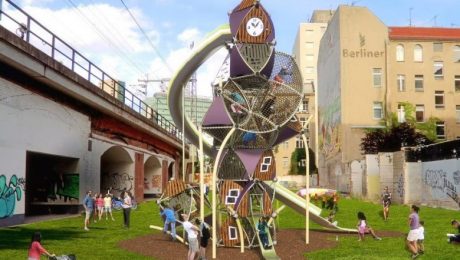
Triitopia combines award-winning design with tried and tested materials in a spectacular way! A magical world of climbing and adventure where reality and fiction melt emerges from the unpredictable interplay of transparent and closed facade elements that are combined in closely-nit, nestled and asymmetric ways.
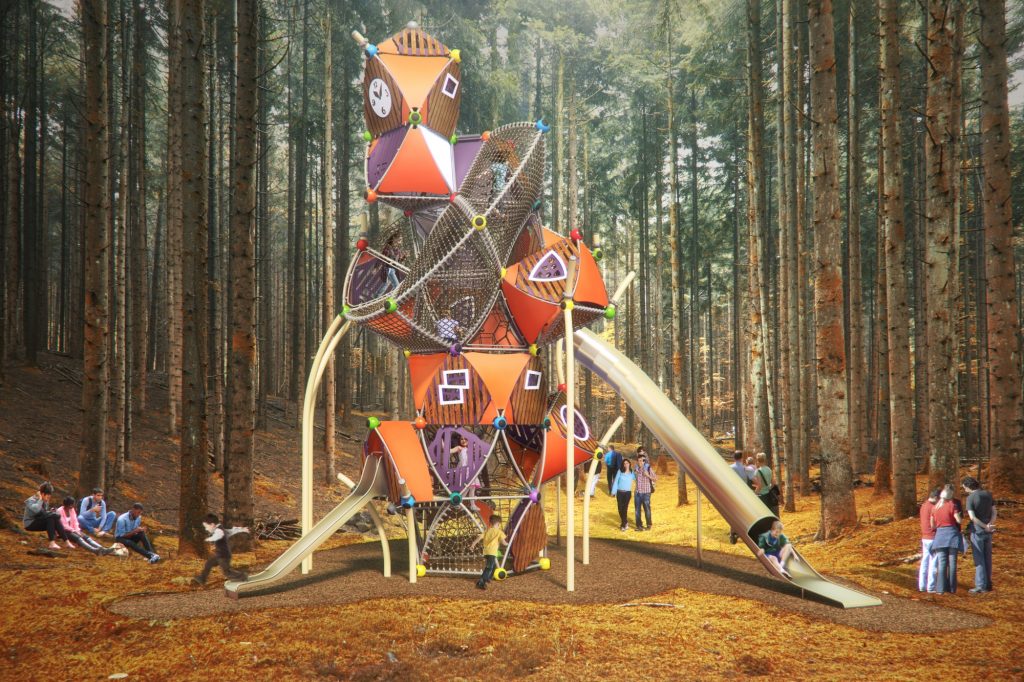
Diverse net pieces invite you to climb and lead to numerous corners, angles and up to viewing areas and slides on different levels. Whether a magic school, bandit’s tower or knight’s castle – anything is possible here!
The chaos has a system! Behind the seemingly random construction method lies a highly modular system that allows every Triitopia structure to be custom designed in shape and size to a maximal extent. To do so, choose from a wide range of different net elements, panel types and types of slides and let your custom adventure world become a reality with us. It goes without saying that Triitopia can be combined with nearly all other Berliner playing equipment.

At a height of more than ten metres and a huge three dimensional net inside, Triitopia.02 offers unlimited possibilities for fun and adventure across a total of seven levels.
Kids will fully enjoy the slightly smaller adventure world. Children that ascend through Triitopia.01 to the very top can swiftly descend the tunnel slide all the way to the ground. Alternatively, the new net tunnel on the facade can be used as an ascent or descent option.
An overview of all details can be found in our new Triitopia brochure. Click here to download or to browse online.
- Published in berliner
- 1
- 2
