
South Park, San Francisco
Written by Berliner Seilfabrik Team
South Park, San Francisco’s oldest public park, is a unique and historical area. The park, modeled after an English strolling park, was originally built as the centerpiece of this exclusive neighborhood. Years of activity, however, took their toll and the park fell into disrepair.

The Recreation Park Department, South Park Improvement Association, park neighbors and community leaders wanted to restore it to its original glory. Fletcher Studio Landscape Architecture, an award-winning landscape architecture firm, was commissioned to develop a master plan for the park, bringing the revitalized vision to reality. The new design can be described as a contemporary interpretation of the English strolling garden.

The project entailed upgrading the park’s infrastructure, including new paths, irrigation, drainage, site lighting, landscaping, swooping meadows and a new stage area for performances.

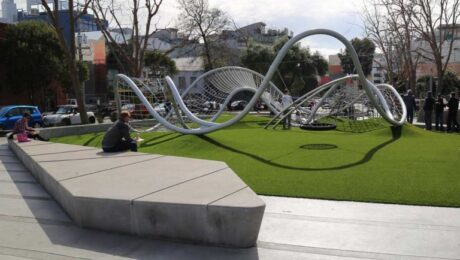
One striking addition: a custom universal play area with undulating forms both in structure and in the mounded surface. This flowing contemporary design by Fletcher and the 100% custom designed structure by Berliner makes it a truly one-of-a-kind design, one that has never been done before!

David Yosso, President of Specified Play Equipment Company and Berliner’s exclusive representative for Northern California, calls the South Park design a “sculptural, playful art piece designed for all ages and imaginations.”

From a bird’s eye view, the play structure appears to be a perfect circle. From an elevation view, you see the undulations and curvatures.
The undulating curvatures rise from two feet to 10 feet with no visible upright posts. All posts, six of them, are below grade. The mounding underneath the playground follows the curvature of the equipment, effectively hiding the upright posts and making the structure appear to float.

The different types of nets offer various degrees of challenge with plenty of footing and handholds for children to safely climb up and down, horizontally and vertically. Net climbers offer visual transparency, keeping sight lines open.
Berliner’s proprietary Charlotte Connectors, which make the rope ends disappear inside the steel tubes, allow for tension adjustments to be made on site, resulting in a more harmonic net geometry as well as improved longevity.

This structure offers a perfect example of the optimum amount of risk with no single route and no known conclusion!
The modern, almost industrial color choice reinforces the concept that this is more than a playground; it is almost like public art, complementing the many tech-related and design companies that call South Park home.
Play elements integrated into the flowing design include a banister, which provides an elegant alternative to a slide, and a multi-user, accessible saucer swing.

The playground in any community provides a distinctive landmark; however, South Park is more than a playground. It provides a lesson in redesigning a public space; combining the play value needed by children with the aesthetic appeal and style desired by adults – making it the perfect place for the whole family.
This is a project reference of Berliner Seilfabrik, in San Francisco. All photos courtesy of Fangzhour Miao and Chris Watkins. If you would like to create a relevant custom-made solution in Greece or Cyprus, please do not hesitate to contact with us at info@eliteareas.gr
- Published in berliner
Rope Play Takes Inclusive Play to a New Level
Written by Berliner Seilfabrik Team
Goggle “INCLUSIVE PLAY” or “inclusive playgrounds” and you will find pages of entries – what it is, where you can find such playgrounds, who offers “inclusive playground equipment” and more.
Delve into this more and you will also find that many traditional inclusive playgrounds primarily focus on children with physical disabilities, failing to include those without physical disabilities or those without disabilities at all.
This raises the question: what kind of inclusion experience is it if it is neglecting over 90% of children who don’t have any disabilities at all to play?
There are many kinds of playground equipment that provide an “inclusive” experience; however, rope play equipment, net climbers, offer something for everyone, providing a more unique and ever-challenging experience for all abilities.

So, What is Inclusive Play?
In general, inclusive play bridges the gap between mainstream and children with special needs. Inclusive play enables children to better relate to one another, whether they have a special need or not, opening their eyes to the world around them.
Inclusive play enables better social integration. Learning about each other’s differences at a younger age can help children feel comfortable around those who are different.
Many children happily play together without noticing any differences. Encouraging children of all abilities to play together teaches them to treat each other the same.
Accessible or Inclusive Playground – What’s the Difference?
A 100% accessible playground goes beyond ADA Compliance, enabling
everyone to get to and move all around the playground. Children in wheelchairs could, for instance, reach the highest point of a structure through ramps. Being ADA Compliant Means…
All new and renovated parks must have an accessible path leading to the playground with nothing blocking it. A paved path and railing facilitates access for children with disabilities and helps meet ADA regulations. Integrating a very tightly stretched rope, for example, into the playground may make the use of a cane for a visually impaired child unnecessary, freeing the child’s hands for climbing. On the other hand, an inclusive playground accounts for human diversity in the community. That means, it offers barrier-free attractions while at the same time providing challenging and fun experiences for a wide variety of children – those without any disabilities along with those with ADHD, Down’s syndrome, sensory processing, visual or hearing impairments and other physical and developmental issues.

An inclusive playground offers a balance of play experiences for all abilities, achieving parallel play as much as possible. It enables children to embrace and experience their commonalities and differences as autonomously as possible and in close proximity to one another.
It is not about “leveling down” the experience nor is it necessary to remove every sandbox so that a child with little mobility does not notice that he or she cannot run.
Inclusive play and accessible play are often lumped together when accessibility is only a small part of what makes a playground inclusive. The ramps alone are merely an accessibility device and do not by themselves lead to engagement with other children. On the other hand, rope play equipment does.
How Rope Play Adds to the Inclusive Experience
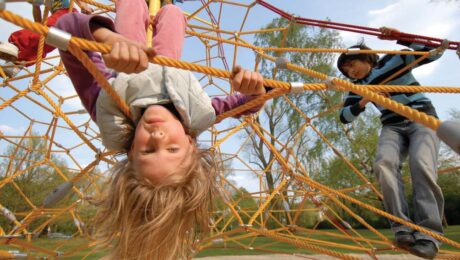
Net structures, or rope play equipment, only serve to enhance the play experience for children, whether at an accessible or inclusive playground. The unique free play and net climbing configurations challenge a child’s motor skills, increase their self-confidence, stimulate imaginative play and improve muscle development and balancing skills.
One strength of rope play equipment lies in the motor challenge that they pose to children along with the endless play options. When climbing, a child’s progress requires control and focus, each step and each grip is a new decision, keeping it challenging and fun every time.

3-Dimensional vs. 2-Dimensional Rope Equipment
Two-dimensional rope structures offer paths for a child to climb vertically, horizontally or possibly across on a bridge or link.
Three-dimensional rope structures come in all shapes and sizes and are commonly referred to as space nets and net climbers. Structures can be quite tall or closer to the ground and full of low course challeng- es or a mix of both, enhancing the play experience with:
- No prescribed entry points
- No specific paths to be followed
- Open environment encourag- ing social interaction
One strength of rope play equipment lies in the motor challenge that they pose to children along with the endless play options. When climbing, a child’s progress requires control and focus, each step and each grip is a new decision, keeping it challenging and fun every time.

For every action, there is a reaction. As one child is climbing the rope structure, it causes a reaction to the other side of the structure. For children who have limited mobility or do not have the strength or desire to climb the structure, he or she can hold the rope and feel its movement, swaying back and forth, and be included in the play with others. Rope play equipment combines different difficulty levels in a single play element. For instance, older children or young adults who like to climb can romp in sections with larger distances between the ropes while younger children can test their motor skills in sections with narrower distances between the ropes. Children of all ages (and sizes) are part of the play experience.
A 3-dimensional net structure has no prescribed entry or exit point; it is up to the child to decide where to go in or come out. is, too, leads to endless play options.
It is important to note that play- grounds must meet all standards and rules of the ADA. That means that all play equipment of a certain size must have some type of transfer module, such as a transfer station or ramp, installed enabling a child to move (or transfer) from his or her wheelchair on to the play structure. The use of transfer modules enables a child in a wheelchair to reach play equipment such as a slide, providing him or her with an easy climbing challenge.

Transfer stations and ramps are not the only viable tools to ensure accessibility. The standard leaves room for alternate solutions if they result in equivalent or better usage. Access nets or other close to the ground nets meet that criteria.
On most rope structures the entire base perimeter serves as a transfer point to the climber. There is no need for an additional transfer module/deck. Rope play equipment encourages children to leave the wheelchair whenever possible.
Rope playground equipment with built-in seats, such as nest swings, are very accessible to children in wheelchairs. The spacious lying area often enables children with or without disabilities to swing together, encouraging social interaction.
The challenging nature of a low-level rope course offers visually impaired children the opportunity to climb safely as well as allowing children with hearing impairments to use sign language without hindrance.
The ropes make communicating among the children and their caregivers much easier. Some children may not speak or hear well. Play can be a wonderful tool for them to use to communicate. The transparency of the net structure enables children to use sign language when playing and eliminates barriers to visual supervision even on very busy playgrounds.
Rope equipment can incorporate elements that allow auditory, visual and tactile sensory experiences, which can capture a child’s interest, especially in children with a form of autism spectrum disorder or sensory processing disorder.
Net climbers provide a play space that brings together children with different abilities – those that may have a visual or hearing impairment, physical or mental disability or other developmental challenge – enabling them to experience their possibilities and their limits in common play, encouraging understanding and acceptance of one another.
If you would like to create a custom-made solution in Greece or Cyprus, please do not hesitate to contact with us at info@eliteareas.gr
- Published in berliner
Margaret Mahy Family Playground in Christchurch, New Zealand
Written by Berliner Seilfabrik Team
With the opening of Margaret Mahy Playground in Christchurch, New Zealand, June 25th 2016, one of the largest and most modern playgrounds in the southern hemisphere has arisen. It was built after the major earthquake that struck New Zealand in February 2011, which affected Christchurch in particular. The project was meaningful for all those involved, but in particular for the area’s inhabitants and visitors to the playground.

The detailed planning phase from early 2013 to mid-2015 included a playground design competition held among schools in the Canterbury region. Entries to this competition helped inspire the final design as drawn up by Berliner Seilfabrik.

The playground’s layout is based on Canterbury’s four main natural habitats: “The Forest”, “The Wetlands”, “The Plains” and “Coastal”. It consists of two different parts. The first section of the playground includes a large custom-made net of 22,5 m x 15 m, stretched across two enormous masts. The net is fixed through a total of 15 anchor points whose foundations are at different heights.

One of the greatest challenges facing the team at Berliner’s Creative Centre was to procure reliable topographical data from the park designers on the ground, since the creation of artificial hills was envisaged as part of the park’s landscape. “An inaccurate calculation of a few centimetres in height difference can lead to a misfit of the whole net. This results either in a sag or a net being too short.”, Marius Kotte, Architect and Head of Construction and Development said.

To prevent this, playground concepts were created, based on which preliminary drafts were then drawn up and offered. With the completion of landscape modelling, the entire site was surveyed. The resulting three-dimensional data set was used by Berliner Seilfabrik to create a virtual site. Based on this, the play structure was conceived, manufactured and installed on site with the utmost precision.
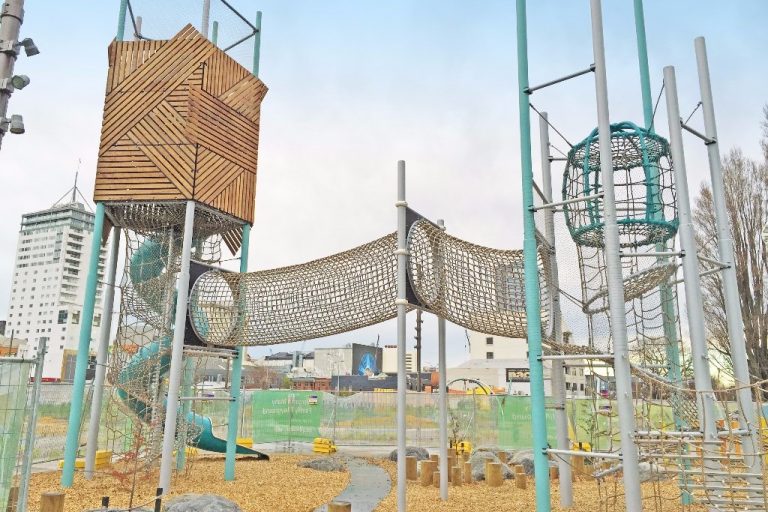
The playground’s second section is characterised by a gigantic tower combination designed and built by Berliner Seilfabrik. The structure consists of three large towers enabling children to climb up to eight meters above ground level. A spectacular spiral slide transports children from the top back down to ground level. Each tower is enhanced by bamboo panels, which has led to their being included in Berliner’s Greenville Towers & Triis product range. “The architect requested special posts and therefore we could not use our standard connector tube.

That’s why we invented a new fastening system which bears high design requirements and the long transportation route to New Zealand. The fact that welding on site was impossible was considered, too.”, Marius Kotte says. To ensure the identification of the individual posts in New Zealand, they have been marked by laser engraving.

As a result, a new and wonderful playground is now located in the Heart of Christchurch. Not only kids are excited, but also their parents and even their grandparents. Leez O’Connell took her granddaughter to enjoy the slide despite the rain. “I think it’s fantastic. Kids aren’t allowed to climb trees or anything anymore. So I really like seeing them all climbing up there and getting a bit scared. It’s so good for them,” she said in New Zealand´s Newspaper THE PRESS.
This is a project reference of Berliner Seilfabrik, in New Zealand. If you would like to create a relevant custom-made solution in Greece or Cyprus, please do not hesitate to contact with us at info@eliteareas.gr
- Published in berliner
Aventura-Europe’s longest playground structure

Written by Berliner Seilfabrik Team
It begins in a shaky fashion at the foot of Bromberg Hill. A large access net leads up to a treehouse-like tower. And this is just the beginning – the beginning of Europe’s longest climbing structure. Meandering 168 meters up the hill are a great variety of tunnels and bridges, balancing elements and rubber mats, which pass through multiple towers along the way.

Planning
“Aventura – Play Mountain” is located in Medebach, a small town and holiday resort in Hochsauerland, which attracts hikers in summer and skiers in winter. After a building phase that was completed in record time, the facility was officially opened at the end of September 2015, having already been given TÜV certification the previous month. The new “playground” is located on land provided by the town of Medebach and forms part of Center Parc, a family resort surrounded by nature. The facility can be used for free by resort guests, visitors to the region and local inhabitants alike. The idea for the construction of a large, recreational facility that was also required in some way to be the only one of its kind in Germany goes back a few years. In 2007, winter storm Kyrill left severe damage in its wake. It was Center Parc’s landscape architect and biologist, Jean Henkens who originally came up with the idea, drawing inspiration from Bromberg being known in history as “where the wind lives”. This led to the choice of air, one of the four elements, to be the underlying theme for the giant climbing structure.
The project was then further developed and implemented by the Paderborn based landscape architectural practice Gasse|Schumacher|Schramm in cooperation with Berliner Seilfabrik.
Implementation
“What makes the project unusual is its scale,” explains Marius Kotte, architect and head of the construction and development department at Berliner Seilfabrik. “Above all, we needed to pay the utmost attention to project management, since the project involved a great degree of planning and development as well as the preparation and implementation of various production processes. The challenge lay in our delivering this major order whilst not neglecting our other clients and their orders.” The project was sub-divided into nine segments, the manufacture of each segment being treated as an individual contract. Structuring the project in this way ensured its completion on schedule. Rising to the challenge of new product development during the construction process proved particularly successful. A number of innovations have been incorporated into Play Mountain: several towers are being seen for the first time, as are the connections between the segments and their connective elements, e.g. between tubes and joints. Although the tallest tower is 7.8 meters high, at no point is it possible to fall any further than the legally-permitted distance of three meters.

Nets inside lead the visitor to a long, spiralling tunnel slide. Another tower is distinguished by a special feature: by lying on a viewing net, visitors can marvel at the wonderful surrounding landscape. These towers are clad in bamboo panels. Berliner Seilfabrik selected bamboo not only because it is more durable than wood, but because it makes a smaller environmental footprint. Being a grass species, after harvesting bamboo can grow again, unlike wood.Suspended between the posts inside two towers are large cocoon-like spheres, access to these being via plate-shaped nets. It was important for these elements to be as transparent as possible while still remaining safe. With this in mind, they were enclosed in a safety net of fine mesh. Such netting was also employed where a small gully is traversed by the climbing structure, at which point a classic suspension bridge is used to cross above a cliff face. Approximately 2000 metres of bright red rope has been used for the 22 connecting elements of the structure. As well as the ever-popular net tunnels and classic suspension bridges, new transitional elements can also be seen, such as the liana bridge, a narrow net walkway suspended from long ropes, not to mention a tunnel enclosed in a rubber membrane. One segment—involving a combination of sloping and balancing—is particularly challenging. It is here that the far from fully grown visitors prove to have a distinct advantage. Also popular is the so-called chessboard bridge, comprising squares of rubber stretched between holding ropes. Here, the children can hop, sway and relax.

Foundations and Impact Protection
Close to thirty six tons of steel was delivered to the building site. Almost one hundred posts were used, the heaviest of which, at 10.4 metres long, weighed 450kg. Test drilling prior to the building phase on the upper reaches of the hill in November 2014 encountered solid rock near the surface. However, while excavating the foundations in June 2015, this rock turned out to be soft shale. The foundations for the posts had to be adjusted accordingly.
On the ground beneath the towers and platforms, the steep gradients were levelled off so as to prevent the impact protection material from being washed away by rain. In some areas wood chips were chosen for impact protection, while in others, turf was selected. The colours of both these blend in with nature while also ensuring the highest safety standards. Over time the lawn areas will change into flower meadows without compromising their impact protection properties.
The gradient of the slope is approximately 21 per cent, but can vary dramatically, at some places reaching as much as 46 per cent. The technical solutions devised by Berliner Seilfabrik allow for small modifications to be carried out to the structure on site. For example, the height of the so-called T joints, which fix rope, chains and tubing to the posts, are adjustable. This allows for any minor revisions to the plan deemed necessary in situ due to vagaries of the terrain.

For Small and Not-so-small Users Alike
Climbing to the top of the structure is not easy. But those who perhaps don’t as yet dare to go through the towers or cross the bridges can play to their heart’s content at the lower end of the facility in an area specially designed for small children. Here they are welcomed by two large nest-swings and “Trii”, a small tree house with a slide. For accompanying adults, a paved path runs parallel to the entire climbing structure.
This is a project reference of Berliner Seilfabrik, in Medebach. If you would like to create a relevant custom-made solution in Greece or Cyprus, please do not hesitate to contact with us at info@eliteareas.gr
- Published in berliner
Museums, Music and Memories – Including Musical Exhibits in Museums Encourages Family Connections

Children’s museums represent one of the fastest-growing segments of the museum community and have been rapidly increasing in number since their beginnings, with new initiatives and exhibitions seeing visitor numbers swell.
With a clear message of fun and learning for all – Children’s museums are unique places that bring children, families, and communities together and provide memorable, immersive learning experiences, provoke the imagination, introduce unknown worlds and subject matters, and offer unique environments for quality time with family.
These museums incorporate an array of activities that contribute to the mental, physical, affective, and social development of children. Museum educators strive to develop programs and activities that address literacy, performing arts, science and math, visual arts, cultures, and health and wellness.
Children represent the leaders of the future – our upcoming innovators, scientists, politicians, CEOs, musicians, artists, teachers, and community members. They shape what the world will become, and engaging this audience is essential. However, while a child may be the reason behind a trip to a children’s museum, it’s an adult that makes the decision to make the visit, assess the experience and decide if they would return. Children’s museums must evolve from engaging only children to engaging the entire family to bring fresh perspectives to exhibits and programs to continue to thrive.

The interactions among family members, spurred by a visit to the museum, can result in a greater sense of family connectedness. Today, family groups come in all different shapes and sizes, from children visiting with their parents or grandparents and even great-grandparents to caregivers with children aging from babies to teens. Whereas some embrace visiting museums with a multi-generational group, it can sometimes be difficult keeping the youngest in your group engaged at the same time as the older ones.
Due to its universal appeal, music can successfully bridge intergenerational gaps. Making music brings people together like nothing else and offering quality musical opportunities – on real instruments – for spontaneous music-making, provides a gateway to the performing arts as well as an engaging family learning experience.
Music ignites all areas of child development: intellectual, social and emotional, motor, language, and overall literacy. It helps the body and the mind work together and helps children develop important skills essential for success in life, such as concentration, confidence, and self-esteem. Young children learn through play and experimentation and by watching and listening to the grownups they love. Setting an example as an enthusiastic participator in music activities is the best thing any parent or caregiver can do to help set a child on the road to a lifelong love of music. Unfortunately, some parents avoid making music with their children in everyday life because they feel inadequate as music-makers themselves. This is a true loss for both generations.
Percussion Play instruments address these feelings of inadequacy by being so simple and easy to play that anyone, regardless of age, ability, or experience, can create interesting and fresh melodies – perfect for beginners and reluctant players. The use of the pentatonic scale in many instruments makes them excellent for improvisation; you can just play around and never hit anything inordinately dissonant in a kind of safe musical haven. The technique is not a problem, given the simplicity of the instruments. Dissonance is not a problem, given the pentatonic scale.
Outdoor musical instruments, with their emphasis on family and multi-generational participation, make a welcome change; often discovery and play spaces have been perceived, either because of their design or because it was assumed, as places for kids only, and adults just stood and watched or wandered off to see the rest of the museum. Through musical play, you are teaching the power and value of music to your child. The result: a joyful, musical child, enhanced family relationships, and a strong, musical community.

Read how outdoor musical instruments were included in the Treetops Outpost at the Connor Prairie outdoor history museum, located in Indiana. The Santa Maria Valley Discovery Museum created a mini music station in their entranceway following a gift from a private donor who specifically wanted to see a musical instrument exhibit in the museum.

We appreciate that not all museums have outdoor facilities or outdoor spaces large enough to accommodate a musical garden or playground. Space was at a premium at the Building For Kids Museum in Wisconsin, but that didn’t stop the Education Coordinator creating a wonderful musical wall in their Arts Studio. For further inspiration check out our case study where the Minnesota Children’s Museum created the exhibit ‘Creativity Jam’ – a musical playground, featuring five Percussion Play instruments, that allows visitors to quite literally jam with family, friends and other visitors, all indoors.

Such shared music-making can facilitate and strengthen relationships between parents or caregivers and their children. What’s more, with all our instruments being designed with inclusive play in mind – nobody is excluded from the fun whatever their ability, mobility, or age. Providing musical experiences for family audiences (indoors or out) is a valuable way to advance a thriving museum’s mission, expand its audience, and strengthen its place within the community.
- Published in percussion-play
