

Author: Milos Milisavljevic, CEO of Strawberry energy
If there was an app giving you real time data about the most crowded shops to avoid or the longest check-out lines during the Christmas shopping fever, you’d welcome that, wouldn’t you? It would require a comprehensively vast digital network of IoT devices, people counters, interconnected shopping malls, a massive amount of data processed in real time. Of course, it doesn’t exist. At least not yet. Furnishing cities with smart technology, building IoT infrastructure and sustainable solutions is slowly becoming the big talking point, a task on every local government’s agenda.
When you dedicate yourself to furnishing your home every detail matters. You start from picking out the comfortable, nicely looking pieces that fulfill your standards of functionality and esthetics. And when you’re done, you call it home. In the recent decade our homes have become increasingly smarter with gadgets helping us or entertaining us every step of the way.
It is no surprise that the need for embedding technology in our public spaces has also become a prerequisite for being comfortable and efficient while running errands out and about the town.

Just like our home, we all want our cities to follow the development, to upgrade and start adapting to our life already submerged in technology so deep that it is an integral part of who we are today as civilisation. But what does it take to furnish a city, to equip it with smart solutions that would not only make our life easier, but also reduce costs, be easy on the local budget and not harm the environment? Is it possible?
In order to talk about the smart city furniture, let’s start with the obvious. What is street furniture to begin with? It includes benches, traffic barriers, bollards, post boxes, streetlamps, traffic lights, traffic signs, bus stops, tram stops, taxi stands, public lavatories, fountains, public sculptures, and waste receptacles. When we want to make all that street furniture “smart” we actually want for it to be more functional, to make our life easier without the cost to the environment.
Smart waste management doesn’t waste time
A decade ago, garbage trucks and sanitation workers would go around at precisely scheduled times, every day, to empty the bins around town so they’d be clean and ready for the new busy day. Of course, a bin in a park near a popular picnic spot or at a busy street is much more likely to be full by the afternoon. Sometimes overflowing with trash by the mid-day. Wouldn’t it be nice if somehow sanitation services would be able to know exactly which bin needs attention and when so that they could plan the collecting routes more efficiently?

Today, smart bins are connected to WiFi and equipped with fill-level sensors that track the situation in real time and send data that the bin needs to be taken care of. Majority of smart bins can be found in France, Germany and the UK, but also in various USA cities and Canada. It’s not a surprise that smart waste management ideas that are sustainable, reasonably priced and efficient in the long term are in high demand.
Next stop: Smart city
Waiting for the bus is a dramatically different experience than 15 years ago when there were no smartphones (as we know them today) or mobile Internet to pass the time. In recent years smart city development has offered us another WiFI connected convenience and experience: a smart bus stop. While you wait for the bus you can check the real time traffic data, pay your bills, top up your phone credit, check pollen and noise levels and in case of emergency there are emergency call boxes, defibrillators and fire extinguishers. Singapore’s smart bus stop network offers free WiFi, phone chargers and in some cases even bookshelves where people can read and swap for the books they have already read. Barselona’s smart bus stops offer detailed tourist info and maps and free WiFi so in a way, every smart bus stop is essentially a tourist info desk.
Stuck in traffic? Not if you’re smart!
Copenhagen municipal government claims that 25,000 tons of CO2 will be reduced by 2025 compared to 2011 levels. How do they plan to carry out that task? Through the city’s ITS (Intelligent Transport System) program. Controllers built in existing traffic lights on busy intersections will control the traffic in real time by favouring cyclists and public transportation. According to globalexplorer.com “Overall, the travel time of cyclists will be reduced by 10% and travel time for buses is expected to decrease by up to 20%… ITS will help Copenhagen achieve its vision to have 75% of all trips in the city be by bike, by public transport, or on foot by 2025.” Benefits for the environment that this measure would bring are quite substantial and if successful, will once again put Copenhagen on the list of one of the most successful cities when it comes to implementing smart technologies to elevate the quality of living.

Smart bench — The new benchmark for smart cities
In 2011, a small startup Strawberry Energy wanted to find new ways to reimagine the city furniture by adding solar panels and phone charging ports powered by solar energy to their project — Strawberry tree. It was a success because it recognized the growing need for connectivity and addressing the environmental issues. In 2015 the first smart bench was installed in London followed by the network of smart benches in 2016 and the presence in more than 25 cities in Europe.

Smart bench has reinvented the “bench time” as we know it. We still sit on a bench to relax, meet up, take a break or eat take out lunch. But as we do it, we also browse the internet using the free and fast WiFi, charge the phone or check the environmental data for the area.
Advertisers gained a new territory to expand their influence and reach the audience. Branded smart bench also offers a branded landing page that pops up when people connect to free WiFi on the bench, allowing an advertiser to display a more personal and customized message for the desired audience depending on the time, weather conditions or current events. The smart bench measures engagement, number of chargings and visitor count, representing a valuable insight into consumer behavior, and above all, promotes the advertiser’s CSR efforts and positions the company as an environmentally aware and proactive.

At the end of year 2020 we already have smart waste bins, smart benches, smart bus stops and smart traffic lights. What the future holds for us and our cities? As it is expected that the AI propels into our life more prominently, no one can reliably predict what impact it will have on urban infrastructure, community engagement and digital transformation. What we can say for sure is that street furniture will definitely become smarter, even cooler and more sustainable.

Do something smart for your city! We’re here to answer any questions! Let’s talk! Contact us at info@eliteareas.gr .
Written by Berliner Seilfabrik Team
South Park, San Francisco’s oldest public park, is a unique and historical area. The park, modeled after an English strolling park, was originally built as the centerpiece of this exclusive neighborhood. Years of activity, however, took their toll and the park fell into disrepair.

The Recreation Park Department, South Park Improvement Association, park neighbors and community leaders wanted to restore it to its original glory. Fletcher Studio Landscape Architecture, an award-winning landscape architecture firm, was commissioned to develop a master plan for the park, bringing the revitalized vision to reality. The new design can be described as a contemporary interpretation of the English strolling garden.

The project entailed upgrading the park’s infrastructure, including new paths, irrigation, drainage, site lighting, landscaping, swooping meadows and a new stage area for performances.

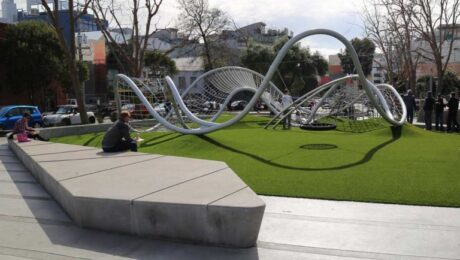
One striking addition: a custom universal play area with undulating forms both in structure and in the mounded surface. This flowing contemporary design by Fletcher and the 100% custom designed structure by Berliner makes it a truly one-of-a-kind design, one that has never been done before!

David Yosso, President of Specified Play Equipment Company and Berliner’s exclusive representative for Northern California, calls the South Park design a “sculptural, playful art piece designed for all ages and imaginations.”

From a bird’s eye view, the play structure appears to be a perfect circle. From an elevation view, you see the undulations and curvatures.
The undulating curvatures rise from two feet to 10 feet with no visible upright posts. All posts, six of them, are below grade. The mounding underneath the playground follows the curvature of the equipment, effectively hiding the upright posts and making the structure appear to float.

The different types of nets offer various degrees of challenge with plenty of footing and handholds for children to safely climb up and down, horizontally and vertically. Net climbers offer visual transparency, keeping sight lines open.
Berliner’s proprietary Charlotte Connectors, which make the rope ends disappear inside the steel tubes, allow for tension adjustments to be made on site, resulting in a more harmonic net geometry as well as improved longevity.

This structure offers a perfect example of the optimum amount of risk with no single route and no known conclusion!
The modern, almost industrial color choice reinforces the concept that this is more than a playground; it is almost like public art, complementing the many tech-related and design companies that call South Park home.
Play elements integrated into the flowing design include a banister, which provides an elegant alternative to a slide, and a multi-user, accessible saucer swing.

The playground in any community provides a distinctive landmark; however, South Park is more than a playground. It provides a lesson in redesigning a public space; combining the play value needed by children with the aesthetic appeal and style desired by adults – making it the perfect place for the whole family.
This is a project reference of Berliner Seilfabrik, in San Francisco. All photos courtesy of Fangzhour Miao and Chris Watkins. If you would like to create a relevant custom-made solution in Greece or Cyprus, please do not hesitate to contact with us at info@eliteareas.gr

Pandemic is Catalyst for Extending Visitor Experiences Outside
As venues adjust their procedures and reduce visitor capacities to ensure they can welcome guests back safely, there has been a renewed focus on the great outdoors that has seen outside spaces, however large or small, becoming key investment areas and successful intersections between wellbeing, the arts, and great family connections.

Making the most of outdoor spaces now and into the future has become a priority; with guests feeling more comfortable spending time outside where they can keep a safe distance from other visitors while enjoying their family day out.
With many museums and attractions having to rethink their programs, shift their focus, and activate their outdoor spaces to offer open-air activities, exhibitions, and events, perhaps they should look to outdoor music as a gateway to the performing arts as well as a fun, engaging family learning experience?
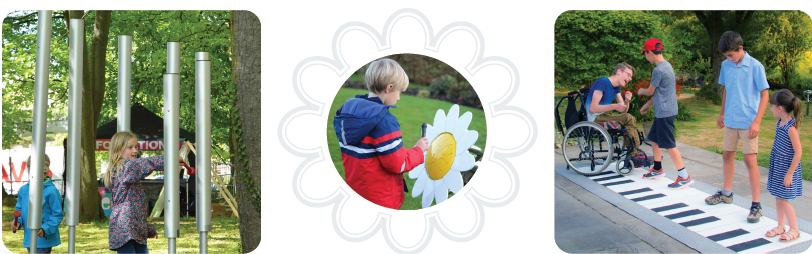
Due to its universal appeal, music can successfully bridge intergenerational gaps. The creation of outdoor music zones for spontaneous music-making, using real-life musical instruments that are holistically interactive, engage multiple senses and are responsive, will be enjoyed by everyone – regardless of age or ability. Knowledge of music, keys, or scales is not required just the willingness to have a go and outdoor musical instruments, with their emphasis on family and multi-generational participation, will make a welcome change or refreshing addition to play spaces or discovery zones outside.
Children learn through play and experimentation and by watching and listening to the grownups they love. Participating in music activities together is the best thing any parent or caregiver can do to help set a child on the road to a lifelong love of music. Music areas or zones are a great way for families and guests to take a calm moment away from the excitement of the main attractions, step away from the crowds, decompress and experience a different kind of activity together. The collection of outdoor musical instruments available represent music-making from many cultures from around the world and therefore invite children and their families to explore global music, rhythms and movement whilst enjoying bursts of post lockdown musical creativity.

One of the many benefits of outdoor musical instruments is they can be installed almost anywhere; indoors or outdoors, on grass, on concrete, on decking, walls, or – in the case of the brand new ‘Stepping Stones’ – even underground! As the instruments are intended to be played while standing on the ground, they do not have any requirements for expensive impact-absorbing safer surfacing and require only a little routine maintenance. The instruments will make robust interactive exhibits that are designed to withstand the elements and live outside all year.
The ending of self-isolation will undoubtedly result in a resurgence of interest in authentic museum and family attraction experiences that cannot be replicated at home online. The addition of a few musical elements outdoors is a reliable way to generate interest and provide unique, educational content to guests while demonstrating an innovative solution to the social distancing challenges presented by COVID-19.
Written by Berliner Seilfabrik Team
Goggle “INCLUSIVE PLAY” or “inclusive playgrounds” and you will find pages of entries – what it is, where you can find such playgrounds, who offers “inclusive playground equipment” and more.
Delve into this more and you will also find that many traditional inclusive playgrounds primarily focus on children with physical disabilities, failing to include those without physical disabilities or those without disabilities at all.
This raises the question: what kind of inclusion experience is it if it is neglecting over 90% of children who don’t have any disabilities at all to play?
There are many kinds of playground equipment that provide an “inclusive” experience; however, rope play equipment, net climbers, offer something for everyone, providing a more unique and ever-challenging experience for all abilities.

So, What is Inclusive Play?
In general, inclusive play bridges the gap between mainstream and children with special needs. Inclusive play enables children to better relate to one another, whether they have a special need or not, opening their eyes to the world around them.
Inclusive play enables better social integration. Learning about each other’s differences at a younger age can help children feel comfortable around those who are different.
Many children happily play together without noticing any differences. Encouraging children of all abilities to play together teaches them to treat each other the same.
Accessible or Inclusive Playground – What’s the Difference?
A 100% accessible playground goes beyond ADA Compliance, enabling
everyone to get to and move all around the playground. Children in wheelchairs could, for instance, reach the highest point of a structure through ramps. Being ADA Compliant Means…
All new and renovated parks must have an accessible path leading to the playground with nothing blocking it. A paved path and railing facilitates access for children with disabilities and helps meet ADA regulations. Integrating a very tightly stretched rope, for example, into the playground may make the use of a cane for a visually impaired child unnecessary, freeing the child’s hands for climbing. On the other hand, an inclusive playground accounts for human diversity in the community. That means, it offers barrier-free attractions while at the same time providing challenging and fun experiences for a wide variety of children – those without any disabilities along with those with ADHD, Down’s syndrome, sensory processing, visual or hearing impairments and other physical and developmental issues.

An inclusive playground offers a balance of play experiences for all abilities, achieving parallel play as much as possible. It enables children to embrace and experience their commonalities and differences as autonomously as possible and in close proximity to one another.
It is not about “leveling down” the experience nor is it necessary to remove every sandbox so that a child with little mobility does not notice that he or she cannot run.
Inclusive play and accessible play are often lumped together when accessibility is only a small part of what makes a playground inclusive. The ramps alone are merely an accessibility device and do not by themselves lead to engagement with other children. On the other hand, rope play equipment does.
How Rope Play Adds to the Inclusive Experience
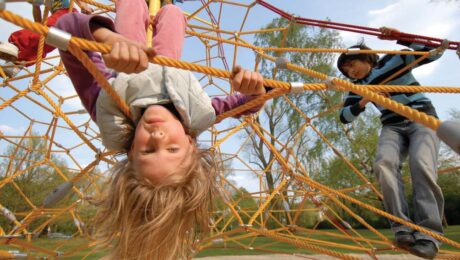
Net structures, or rope play equipment, only serve to enhance the play experience for children, whether at an accessible or inclusive playground. The unique free play and net climbing configurations challenge a child’s motor skills, increase their self-confidence, stimulate imaginative play and improve muscle development and balancing skills.
One strength of rope play equipment lies in the motor challenge that they pose to children along with the endless play options. When climbing, a child’s progress requires control and focus, each step and each grip is a new decision, keeping it challenging and fun every time.

3-Dimensional vs. 2-Dimensional Rope Equipment
Two-dimensional rope structures offer paths for a child to climb vertically, horizontally or possibly across on a bridge or link.
Three-dimensional rope structures come in all shapes and sizes and are commonly referred to as space nets and net climbers. Structures can be quite tall or closer to the ground and full of low course challeng- es or a mix of both, enhancing the play experience with:
- No prescribed entry points
- No specific paths to be followed
- Open environment encourag- ing social interaction
One strength of rope play equipment lies in the motor challenge that they pose to children along with the endless play options. When climbing, a child’s progress requires control and focus, each step and each grip is a new decision, keeping it challenging and fun every time.

For every action, there is a reaction. As one child is climbing the rope structure, it causes a reaction to the other side of the structure. For children who have limited mobility or do not have the strength or desire to climb the structure, he or she can hold the rope and feel its movement, swaying back and forth, and be included in the play with others. Rope play equipment combines different difficulty levels in a single play element. For instance, older children or young adults who like to climb can romp in sections with larger distances between the ropes while younger children can test their motor skills in sections with narrower distances between the ropes. Children of all ages (and sizes) are part of the play experience.
A 3-dimensional net structure has no prescribed entry or exit point; it is up to the child to decide where to go in or come out. is, too, leads to endless play options.
It is important to note that play- grounds must meet all standards and rules of the ADA. That means that all play equipment of a certain size must have some type of transfer module, such as a transfer station or ramp, installed enabling a child to move (or transfer) from his or her wheelchair on to the play structure. The use of transfer modules enables a child in a wheelchair to reach play equipment such as a slide, providing him or her with an easy climbing challenge.

Transfer stations and ramps are not the only viable tools to ensure accessibility. The standard leaves room for alternate solutions if they result in equivalent or better usage. Access nets or other close to the ground nets meet that criteria.
On most rope structures the entire base perimeter serves as a transfer point to the climber. There is no need for an additional transfer module/deck. Rope play equipment encourages children to leave the wheelchair whenever possible.
Rope playground equipment with built-in seats, such as nest swings, are very accessible to children in wheelchairs. The spacious lying area often enables children with or without disabilities to swing together, encouraging social interaction.
The challenging nature of a low-level rope course offers visually impaired children the opportunity to climb safely as well as allowing children with hearing impairments to use sign language without hindrance.
The ropes make communicating among the children and their caregivers much easier. Some children may not speak or hear well. Play can be a wonderful tool for them to use to communicate. The transparency of the net structure enables children to use sign language when playing and eliminates barriers to visual supervision even on very busy playgrounds.
Rope equipment can incorporate elements that allow auditory, visual and tactile sensory experiences, which can capture a child’s interest, especially in children with a form of autism spectrum disorder or sensory processing disorder.
Net climbers provide a play space that brings together children with different abilities – those that may have a visual or hearing impairment, physical or mental disability or other developmental challenge – enabling them to experience their possibilities and their limits in common play, encouraging understanding and acceptance of one another.
If you would like to create a custom-made solution in Greece or Cyprus, please do not hesitate to contact with us at info@eliteareas.gr
