

From the earliest times, drums and their rhythms have been at the center of social and cultural activities all over the world, in fact, it is said to be man’s oldest musical percussion instrument. Drums have been used in every culture for many purposes from religious rituals and ceremonies, to sporting events and as a way to communicate or signal.
Drumming has also been used therapeutically since ancient times and now the primitive drumming circle is emerging as a significant therapeutic tool in the modern technological age. Drums and drumming are increasingly being used as a powerful means of improving health and well-being, personal development, and improving communication by large companies, service clubs, music therapists, youth groups, schools, and communities.

Drumming circles, ensembles, and making music together in a group can be a unifying experience – encouraging self-expression and camaraderie as well as lots of hands-on fun! Drumming together is a tool for unity. It breaks down barriers, builds personal and team confidence, releases stress, motivates, and creates spontaneity.
Many service clubs and community groups have created informal drum circles and workshops to bring children and adults together in a fun-filled, cooperative environment where they can build community spirit, and learn a new skill that they can even take away and share with their friends. Clubs such as the Wilmington Rotary who proudly unveiled the Jonathan P. Whitcomb Memorial Music Circle in their local park to engage the whole community and introduce music-making in the outdoors to people of all ages and all abilities. The music circle included several stainless-steel drums designed for permanent outdoor use and recommended for high-use public areas.

Drumming captures the heart of most who encounter it and with when playing hand drums, such as those used in the Wilmington Music Circle, you don’t have to worry about melody or chords, and absolutely NO previous musical experience is required.
So, it seems the drum continues to play a central role in our society. Why not find the rhythm and beat of your own drum? There are many drumming communities across the world promising anxiety release, physical toning, spiritual growth, creativity, and personal empowerment whilst being a whole lot of fun – and who couldn’t use that?

Benefits of Drumming and Drum Circles
Induces relaxation and reduces tension, anxiety, depression, and stress
Quite simply, drumming makes you feel great! It helps synchronize the body’s natural rhythms while making you feel as one – connected and peaceful. In one study, blood samples from participants who took part in an hour-long drumming session revealed a reversal in stress hormones.
Gives a boost to the immune system and accelerates physical healing.
Neurologist Barry Bittman, M.D. of the Yamaha Music and Wellness Institute, and his research team discovered that drumming significantly increases the body’s natural T-cells, which help combat cancer as well as other viruses.
Increases energy levels
Playing with tempo and speed will get your blood flowing by speeding your heart rate slightly, improving circulation, sending oxygen and nutrients soaring through your body and brain, and giving your cells more energy to burn.
Eases pain
Thoughts, emotions, and sensations are interconnected elements of the human condition, and one’s entire self is affected when in pain. Whether chronic or acute, pain is exacerbated by stress and anxiety. Music therapists use drumming as a method of holistic pain management, with the influence of rhythm and beat being felt on physical, mental, emotional, and spiritual levels.
Boots confidence and releases negative feelings and emotions
Drumming is an exercise in creativity and self-expression. Playing music or hitting a drum, like a Djembe or Cajon, has the ability to bring out a natural zest for life through personal expression – you can literally drum out your feelings! Opportunities for building self-esteem can be found in the mastery of the drum, the creativity allowed by drumming, and the experience of drumming with others.
Making social interactions, sense of community and connectedness
It is a long-known fact that music creates bonds and community drumming has proven to be an exceptional activity to empower children and adults and family and friends alike. Drum Circles provide an opportunity for participants to feel connected with others and gain a sense of interpersonal support.
Improving Language and Communication
Drumming is an ancient nonverbal method of communication. When drumming in groups, you learn the art of listening and become keenly aware of your fellow drummers. The subtle awareness can become so great that some people report an empathic response.

Tourism Organizations Budva (TO Budva) is in charge of promoting tourism of their local municipality, as well as performing other duties relevant for the development of communication and advertising activities in Montenegro tourism.

Challenge
TO Budva was running Zero Waste Project and was searching for solution that can promote sustainability initiatives but also to serve as central information point to tourists in the city.
Solution
TO Budva recognized Smart Bench as innovative tool that can increase the tourism potential and provide advance tourism experience. The bench serves as:
• Central tourist info point
• Digital content platform that is constantly enriched with new useful information
• Tool that can have new functionalities added (e.g. wayfinding, ticket purchase…)
• Physical representation of municipality’s green initiatives

Personal quote from client
“The aim of this project was to raise the quality of the tourist offer we have in the city of Budva. Small, modern projects, like Smart Bench, in the best interest of our tourists, but also fellow citizens, will become a priority in the development of our touristic destination,” said the representative of Tourist Organization of the Municipality of Budva, Montenegro.
We’re here to answer any questions! Contact us at info@eliteareas.gr .
Written by Berliner Seilfabrik Team
Be’er-Sheva in southern Israel is one of the country’s largest cities. It is considered by many to be the “Capital of the Negev,” which it borders on. As a so-called “developing city,” Be’er-Sheva has been turning into a religious center and has also become an important Israeli metropolis over recent decades.
In order to maintain the city’s attractiveness for its 200,000 inhabitants, it is crucial to create attractive facilities for young families. In addition to emerging residential neighborhoods, the growing industrial sector and increasing tourism, new local parks have been established in the last few years. One of these is Be’er-Sheva River Park. Covering an expanse of several square miles, the large River Park follows the course of Nahal Be’er-Sheva, a large riverbed that does not carry any water during the dry season.

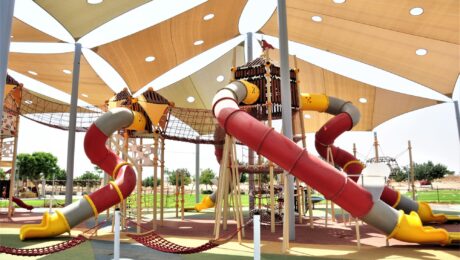
As of June 2017, the park boasts a new centerpiece: a massive playground consisting of a vast climbing landscape made up of equipment provided by Berliner Seilfabrik.
Seven differently equipped climbing towers are evenly distributed over an area of approx. 10,765-ft.² They serve as the foundation pillars of this climbing paradise. The towers are connected with net bridges that are up to 20 feet in length. Some of the bamboo-clad towers are more than 26 feet high, giving them the appearance of a tree house village thanks to their natural design.
Besides its remarkable size and complexity, another special feature of the playground is its density of climbing structures and the way these are connected. Any “gaps” have been filled using additional exciting equipment. Climbing mats, ladders, nets and climbing ropes add many more options for climbing and playing, making the playground even more versatile. A neighboring lower rope course for children who are not quite ready to make their way up to the “treetops” offers additional variety and an exciting challenge for smaller children.
In addition, six long, slightly twisted or even spiralling slides have been attached to the climbing towers. Whizzing down one of these slides is the perfect reward to every bold climber! The slides for this project were supplied by Israeli partner Games & Sports and could be easily attached to the towers thanks to Berliner Seilfabrik’s modular system.
Around the climbing structures, numerous additional attractions such as seesaws and carousels complete the playground’s range of activities in an impressive fashion.

The new climbing landscape has been designed in cooperation with Games & Sports Head of Design, Galina Man, and the company’s Vice President of Marketing, Meirav Moshka, with the planners at Berlin’s Creative Centers. Roei Shabtay, Executive Assistant to the CEO at Games & Sports, is more than happy with the result. In particular, he loves how “every area offers a different activity”.

Another specialty of the playground is its distinctive canopy. The entire climbing structure is protected by multiple shade sails arranged in a star-shaped pattern. As severe dust storms can be quite a frequent occurrence in the Be’er-Sheva region, these sails give not only shade, but also protect the playground structures and their users from the bothersome fine grains of sand. Several poles were installed to attach the canopy.
Roei Shabtay explains, “We had to pour a joint foundation to be able to anchor this great number of poles in the ground. The poles for the playground equipment and the poles for the shade sails share one foundation.” Despite the large amount of poles in one place, the designers managed to observe the necessary clearance distance, thus ensuring maximum safety for the children.
This is a project reference of Berliner Seilfabrik, in southern Israel. If you would like to create a relevant custom-made solution in Greece or Cyprus, please do not hesitate to contact with us at info@eliteareas.gr

Written by Harrie Kerkhof, Director of Operations at Yalp Interactive
Earnings over cost
In the year 2000, I started working in the playground industry, and I can honestly say that I have donated my heart to PLAY. What a fantastic industry, I cannot see myself working anywhere else with the same passion.
In the past years, I have fulfilled various roles from sales to marketing to an export manager traveling the globe. I met a great variety of customers, colleagues, marketing, and sales teams abroad, which I was privileged to meet and present. Looking back on those years, I learned that our industry is often budget-oriented. A playground almost always includes a slide. Are we not consistently doing more of the same? Shouldn’t we broaden our offering?
What are the right questions?
Take an average city of 80.000 inhabitants. This city might have approximately 100 play and sports areas to maintain. They can vary from a small stand-alone rocker installed on a sidewalk to a large destination playground in a city center park and everything in between. What is it that sets our playgrounds apart? Because while they may all look different, most offer very similar play values(sliding, climbing, swinging, etc.), while targeting the same group.
I genuinely believe any city today investing in a new playground, will contribute significantly to our society. Being physically active outdoors while developing our motor and social skills is tremendously important. But I also genuinely believe we can get more out of playgrounds.
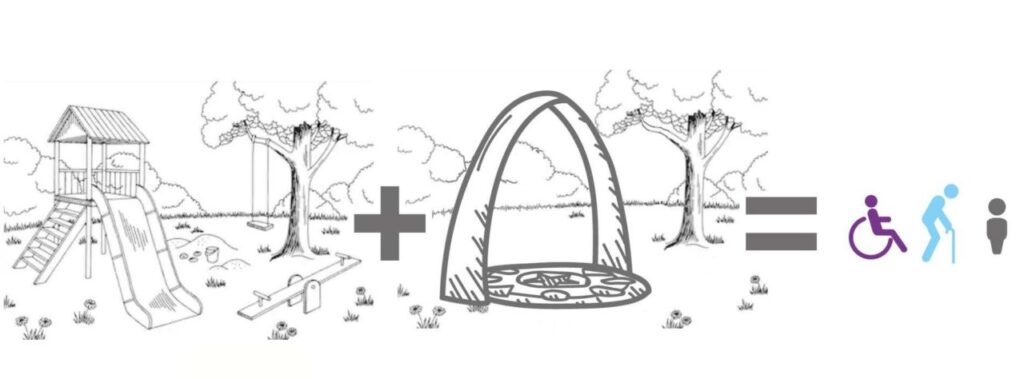
Having a disability places you in the world’s largest minority group. Over a billion people live with a type of disability. And between 110-190 million adults have significant difficulties in functioning (source World Health Organisation). These numbers should speak for themselves, but there is much more to it. What if we truly ask ourselves, “Who do we like to include?”
We all know there is much more to inclusive play than merely making a playground accessible for those using mobility devices.
But what about including parents and grandparents? Or even more out-of-the-box, including those who do not regularly visit a playground yet?

Getting everyone involved!
Shouldn’t we also focus on getting the less active individuals more engaged?
I often use the example of a new soccer pitch. Success is guaranteed in our soccer continent Europe. But are the earnings inline with the investment? Do we achieve our goals? Will this new activate the group of inactive? Will it activate the more obese boys and girls? Or will we stick to more of the same for the same group of people? The boys and girls who already play outside and now also have another play area to go to.
As a father, my best experiences involve playtime with my son and daughter. And I do not mean the experience when I was sitting at a bench in the playground waiting for them to stop playing, which may be recognizable, because I find myself often in a rush with my busy Saturday schedule. No, I mean the times we played together and created our memorable moments. With their ages now 12 and 15, we do not visit the slides and swings anymore, but often we can be found in our outdoor showroom at the Yalp office. 😊

Good practice from Australia
Recently I watched an interactive play webinar from our distributor Lark Industries. Compliments to Ryan, the presenter on how he reviewed and analyzed a project with an ever-popular Sky Walk tower installation, a destination structure, which offers climbing and sliding, from exciting heights. A concept that is popular, but as we all know, a significant investment. By comparison, for a similar investment for one large play tower structure, one would invest in a full interactive play park, containing five varied play solutions, with play possibilities for sport, learning, music, dancing, agility, and physical exertion. I believe the earnings would be exceedingly higher with a lower investment.
Just take a look at the video below, presenting our take on future playgrounds.
I also fully agree with their statement interactives are not designed to substitute the traditional play all children love. Their proper place is alongside these traditional play experiences, as a new, exciting, and ever-evolving way to play. But even a stand-alone interactive can provide a unique play experience at limited costs.
Good practice from Norway
Another example I’d like to share is the Memo at the Dale Skule. To me, a great example of a school looking more to the earnings by putting the focus on playful learning, 20th-century skills, and interaction. They followed their dream and dared to invest in ‘A new way to play,’ our company’s payoff😉.
The phrase “playing and learning go hand in hand” appealed to us when we had the opportunity to design our new schoolyard. We believe that digital learning, physical activity, and interacting children are key factors to education in the 20th century. Our vision at Dale school is to be a digital school and a school for the future. We were pleased to discover that we could bring this vision to our playground as well, by investing in Yalp Memo. The Memo brings activity to the playground throughout the day, not just during school hours – which is positive for our community.
Malin Sæterdal – Teamleiar, barnetrinnet Dale skule – Norway

Static or dynamic
As the interactives are internet-connected, we can provide dynamic content or game updates, remote access, and analytical data, all significant to the solutions’ long-term value.
In Norway’s good practice, this means we can provide the customer with feedback on how well the product is being used. They can then mirror this to their investment. Last year alone, Yalp provided 290.000 hours of play to the world. This makes me proud and passionate about what we do!

Put it to the test
I want to end this blog with a small exercise. Below I have listed items to score from 0 – 10. Of course, you can expand this list to your wishes. For example, add competition, the possibility to play in the evening, 21st-century skills. You are your own judge, so it can not be done wrong. How cool is that!
For example, I scored a standard playground consisting of a swing, sandbox, play tower with a slide and climbing element. I rated this playground with 52 points (see table). Next, I scored one Yalp Sona Interactive dance and play arch along with the same measurements, scoring 90 points. When dividing the budget by the score, you find the investment rate is lower with the Sona.
Please do not make false conclusions. In my perfect world, I would opt to raise the budget to combine traditional with interactive play.
In conclusion, please consider doing things differently and with a clear vision of what you want to achieve. In the playground business, I preach to look more to the earnings. This might add much more value to your city or business. You might surprise yourself seeing elderly play together with teens and small children and others challenging each other and having even more FUN together.
Play-is-on.

We’re here to answer any questions! Contact us at info@eliteareas.gr .
